
The state has the power to monitor our communication, legally. I may say it’s illegal though. A long court battle has finally reached its end after the court ruled in favor of the state in one of the most sensitive cases in the history of modern communication in Kenya. The communication authority of Kenya (CA) has finally been given the green light to snoop on Kenyans. In a court ruling that overturned the ruling by the high court, the communication authority of Kenya has been allowed to install a Device Management System on all mobile subscription companies that will monitor every communication devices within the country and without, as long as they utilize Kenyan satellites and Telecommunication systems.

The Communications Authority of Kenya (CA) is the regulatory authority for the communications sector
in Kenya. Established in 1999 by the Kenya Information and Communications Act, 1998, the Authority is responsible for facilitating the development of the information and communications sectors including; broadcasting, cyber security, multimedia, telecommunications, electronic commerce, postal and courier services.
OBLIGATIONS OF THE AUTHORITY
- Licensing all systems and services in the communications industry, including;
telecommunications, postal, courier and broadcasting. - Managing the country’s frequency spectrum and numbering resources.
- Facilitating the development and management of a national cyber security framework.
- Facilitating the development of e-commerce.
- Type approving and accepting communications equipment meant for use in the country.
- Protecting consumer rights within the communications environment.
- Managing competition within the sector to ensure a level playing ground for all players.
- Regulating retail and wholesale tariffs for communications services.
- Managing the universal access fund to facilitate access to communications services by all in
Kenya. - Monitoring the activities of licensees to enforce compliance with the licence terms and conditions
as well as the law.
THE ISSUE AT HAND
Of the three companies, Safaricom boss Collymore said the system raised key concerns, among them privacy and confidentiality of consumer information as CA had hired a third-party — Broadband Communication Networks Limited (BCNL) which was partnering with Invigo Off-Shore Sal, a Lebanon based firm— to run the system for Sh187 million. That means the CA was not going to operate the system by itself.
- VIDEO: AL-SHABAAB, a Somali based al-Qa’ida affiliate, names the 5 attackers behind DusitD2 attack.On December 6, 2017, US President Donald Trump announced the United States recognition of Jerusalem as the capital of Israel and ordered the planning of the relocation of the U.S. Embassy in Israel from Tel Aviv to Jerusalem. This decision shocked the entire world. In response, Islamic terror organisations responded with a wave of attacks… Continue Reading →
- Architect of Operation Linda Nchi, President-Elect Joe R. Biden. The war on Terror.As CNN projected Biden as the winner of the 2020 presidential elections, Kenyans were overjoyed, perhaps because he worked for Barrack Obama. Unfortunately, very few understand his intimate connection with this country and how his political career spanning decades, has influenced Statehouse. His key involvement in sending Kenyan troops to Somalia is often ignored. The… Continue Reading →
- GBWhatsApp: THE TECH-CARELESS GENERATION.It is a generation that has fought hard against governments having authority to access software and telecommunication companies private user data. However, the same TECH-GEN is careless and intentionally supports cyber insecurity by signing up to illegally modified applications. Regrettably, they would not listen when advised on the right thing to do. This is dangerous… Continue Reading →
CA wrote to Safaricom, Airtel and Telkom on October 10, 2016 notifying them that it intended to install a Device Management System (DMS), the reason being combating the proliferation of counterfeit mobile phones and international calls which were masked as local calls, and which denied the telecommunication companies revenue.

The CA wanted connectivity between the DMS and the telecommunication companies’ systems to access information on the IMEI, IMSI, MSISDN, and CDRs of subscribers.
IMEI is a unique number that identifies your mobile phone, International Mobile Subscriber Identity (IMSI) is a number which uniquely identifies every user of a cellular network. Mobile Station Integrated Subscriber Directory Number (MSISDN) is your mobile number. Meanwhile, CDRs (Call Data Records) are records containing details of a telephone call or other transactions. They include your location, time, duration, the receiver and whether the call was connected.
THE JUDICIAL BETRAYAL.

Safaricom went to court to protest the propose access to consumer data. The matter was heard at the High court. After years of battle, the ruling was delivered. Justice john Mativo in his ruling at the high court of Kenya declined to give the CA the go ahead to integrate a system to monitor Kenyan mobile communication.
“Subscribers data held by the first to the third interested parties can only be released under the circumstances permitted by the law, and in particular Section 27A of KICA. There is no argument before me to demonstrate that the DMS fits any of the circumstances contemplated under the said section. Nor is there a strong argument by CA rebutting the position taken Safaricom on the capabilities of the DMS,” he ruled
However, the authority (CA), appealed against this ruling and the matter was therefore moved to the court of appeal.
Unfortunately, to the advantage of the communication authority, the ruling at the high court was overturned. The three-bench judge ruled that justice Mativo had based his ruling on bias and that he had not given a keen look at the dangers facing this country and the emerging challenges in the telecommunication system.
“He, however, did not consider other aspects of ‘access’ such as making use of the resources to address the challenges at hand. We state this cautiously, noting that in accessing the data there was fear that the right to privacy was likely to be infringed, which seems to have preoccupied the judge,” they ruled.
INFRINGEMENT OF PRIVACY.

At this level, Kenyan privacy is at risk as other government agencies will have access to the system and thus increases the chances of snooping and listening in to conversations of individual Kenyans, illegally.
The law is very clear on how to intercept metadata. It states that a court order will be issued on a basis
that whatever communication going on at a particular time threatens the peace or the normal running of the state (Republic of Kenya).
The CA states that other agencies will have access to the system and they include:
1) The National Intelligence Service
2) The National police Service
3) the Anti-Counterfeit Agency
4) Kenya Bureau Standard (Kebs)
THE NATIONAL INTELLIGENCE SERVICE.
The service is one of the biggest budget spenders in this country’s the security docket. With the rise of terrorism in the country and pressure from the public for the government to deliver on its primary mandate of keeping Kenyans safe, Uhuru Kenyatta’s government has annointed the agency with money. Hundreds of billions have been poured into the agency, in an effort to expand their ability to gather high quality actionable intelligence. High-Tech, modern and sophisticated equipment has been installed in different parts of the country and the agency has hired some of the best experts available in the country from the entire professional spectrum.
Of all the agencies the CA has mentioned that will have access to the system, they (NIS) are the most controversial. Their access to this kind of immense data sends chills. It should be noted that The Special Branch, had all the claws and teeth it needed to bite and tear down the “enemies”. The “enemies” were taken to Nyayo torture chambers where their human rights were violated. For this reason, it was detached from the police and systematically dismantled. This happened as a result of Opposition parties gaining more seats in Parliament. It would be soon replaced by the NSIS (the predecessor to NIS) in 1999. The NSIS had its authority and mandate reduced immensely, in order to put a check on their involvement in democratic processes. The authority to arrest and prosecute was quashed.
The national intelligence service is a civilian intelligence agency established under article 242 of the constitution of Kenya 2010, to be primarily responsible for security intelligence and counter intelligence, besides performing other functions prescribed by national legislation. Its official existence was effected with the adoption of The National Intelligence Service Act, 2012, effectively replacing the National Security Intelligence service (NSIS) that had been formed in 1999.
It is a very powerful security apparatus, placed at the center of governance in the republic of Kenya. They operate in total secrecy. Their headquarters are known by a few individuals outside the service. Their budget is strictly classified and so is the number of their employees. They have no uniforms (by virtue of being a civilian agency) and are well spread across the country. The spies are sworn to secrecy and are impossible to identify in public unlike other security agencies. Close to 80% of the employee are drawn from the military intelligence, partly due to experience they’ve obtain in several operations abroad and locally.
It is headed by a director general, appointed by the president. His immense influence can be attributed to the fact that he is the country’s chief national security advisor. The director’s daily intelligence briefs to the president has helped build a personal bond.
For this reason, it is easy for the president to get the director to “work on his side”.
In the aftermath of the death of Professor George saitoti, the pathologists revealed to the committee investigating the accident that they had been called by the NIS and instructed not to reveal very critical information. Some findings would be left out of the pathology report. Immediately, the NIS began listening and tracking the doctors’ communications. It’s since been questioned why the Agency was involved in the cover-up of the murder of a Cabinet Minister who was actually their boss. The fact that Saitoti died in a fishy helicopter crash a week before he was to report drug kingpins to the US Drug Enforcement Administration (DEA) raises the amount of distrust Kenyans have in the Agency.

IS NIS CAPABLE OF SNOOPING ON KENYANS?
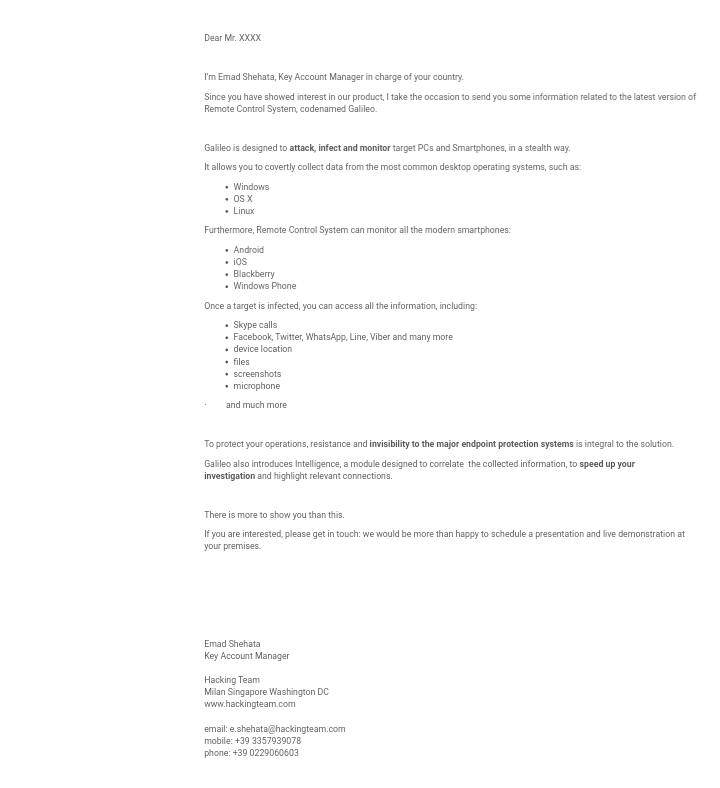
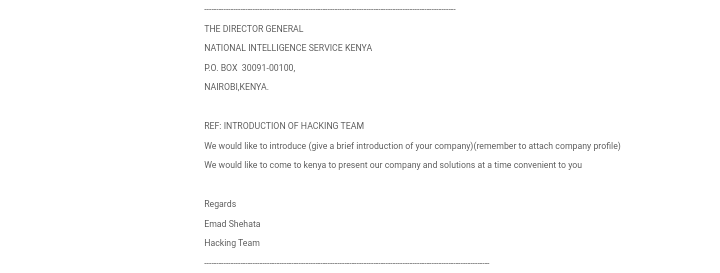
The answer is yes! The ruling by the Court of appeal to allow the CA to access metadata gives the NIS easy access to consumer information and communications without a sweat. You see, it’s very easy for such agencies to work together since they have a common goal. They have attempted to gain such access before. On 9th July 2015, the revered whistle blowing website WikiLeaks published classified business dealings with the hacking team. The leaked emails give a clear account how the Agency worked to acquire the snooping Tool, Galileo. By the time the emails were published by WikiLeaks, the deal had long been finalized and the software had already been delivered to the agency and was already in use.
Conclusively, the fact that the national intelligence service will have access to the DMS puts the privacy of Kenyans at risk. It expands the scope of what is before their glass.
You can join our Telegram documentary channel here
 The Explainer